Row Repeatable AMRAP
row wod
AMRAP 12
250 m row
8 controlled air squats
Keep every round within a consistent pace
By Borja Bes — CrossFit Athlete & Hyrox Finisher
Technique demonstration
Watch the full movement, then use the original coaching image to check the key position.
Correct Rowing Machine Technique, Improve Your Rowing | Concept2
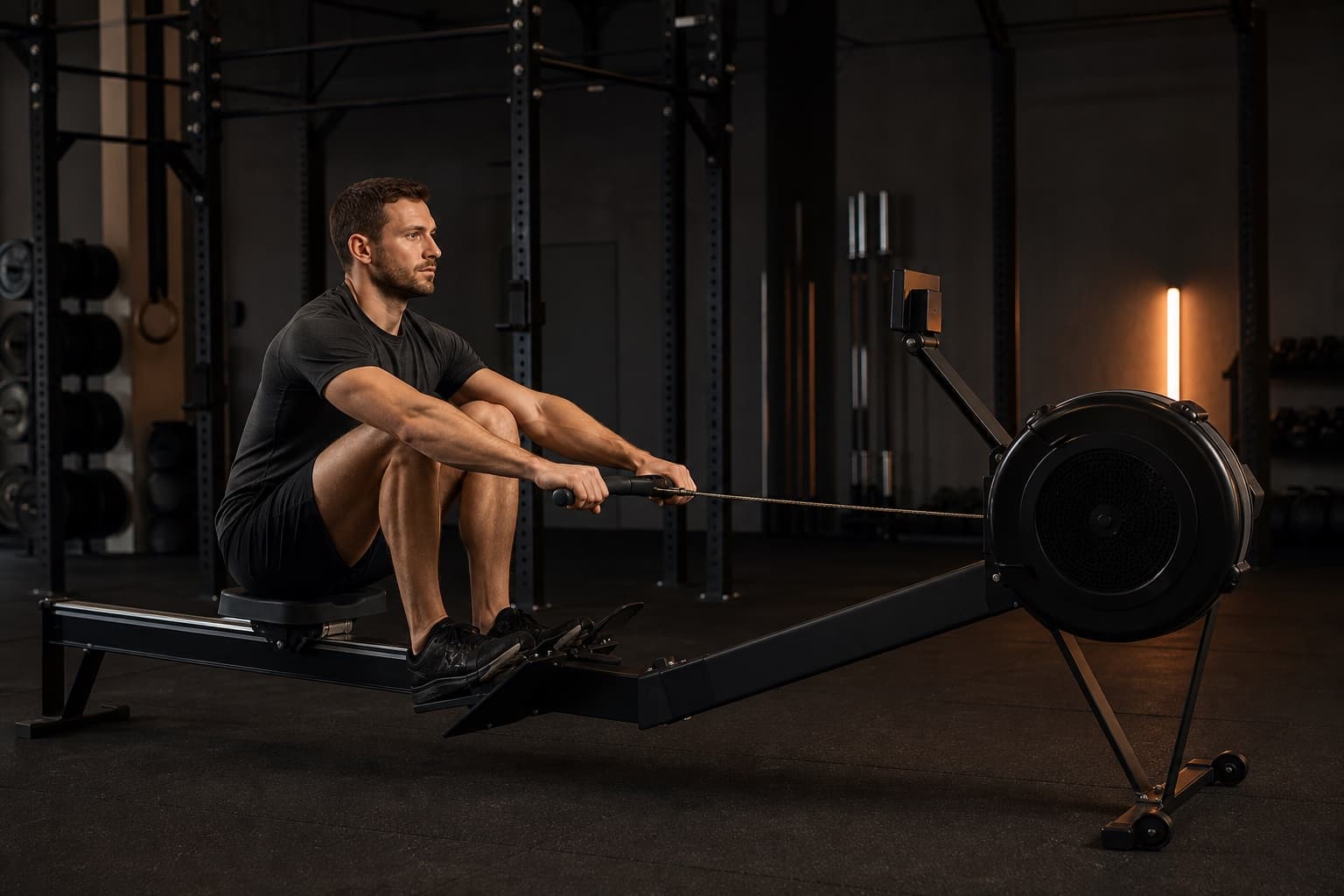
Key position
At the catch, keep the arms long and the spine neutral so the legs can start the drive before the handle is pulled.
Video by concept2usa · reviewed 2026-08-06
Rowing (typically on a Concept2 ergometer) is one of the three primary monostructural cardio machines in CrossFit, alongside the ski erg and assault bike. In WODs, rowing is usually prescribed in calories rather than metres because calories normalise output across body weights — heavier athletes naturally pull more metres per stroke. The rowing stroke is a technical skill: 60% of the power should come from the legs, 30% from the back, 10% from the arms. Poor rowing mechanics — driven entirely by the back and arms — are extremely inefficient and lead to rapid fatigue.
Quick answer
Indoor rowing is best for full-body conditioning with measurable pace and low impact. Sequence each stroke legs, body, then arms; reverse that order smoothly on the recovery.
Muscles Worked
Equipment
| Best for | HYROX and CrossFit intervals, aerobic development and repeatable full-body conditioning with clear pacing. |
|---|---|
| Avoid if | Hip or low-back pain makes the catch collapse, or you cannot control the recovery at the chosen stroke rate. |
| Scaling | Reduce calories/distance, or substitute with 400m run or 400m bike. |
Set foot stretchers so the ankle is at 45° when the handle is at the belly button.
Start at the catch: shins vertical, leaning slightly forward, arms extended, back neutral.
Drive with the legs first — push the platform away with full leg power.
Once legs are nearly extended, lean back to approximately 11 o'clock.
Finally, pull the handle to the lower sternum — elbows driving past the body.
Return in reverse: arms extend first, then lean forward, then bend knees back to the catch.
Opening the back before the legs are extended — loses leg drive before the chain is fully engaged.
Arms bending before the legs are straight — defeats the sequencing.
Rushing the recovery (getting back to the catch too fast) — increases stroke rate without increasing power.
Ignoring the monitor — pacing blind prevents adjustments during the workout.
Match your rowing pace to what you can sustain through the entire workout, not your max effort.
A lower stroke rate (22-26 SPM) with a powerful drive is more efficient than a high rate (30+ SPM) with a weak pull.
Damper setting: most CrossFit athletes use 4-6. Setting it to 10 is not harder — it just slows the flywheel.
Easier / Beginner
Reduce calories/distance, or substitute with 400m run or 400m bike.
Harder / Advanced
Higher target wattage/split, or pair with another movement for a buy-in/buy-out structure.
Training Examples
row wod
AMRAP 12
250 m row
8 controlled air squats
Keep every round within a consistent pace
row conditioning
Every 3:00 x 6 rounds
250 m row
8 controlled bodyweight reps
Rest for the remainder; avoid a first-round sprint
The damper (vent on the side of the flywheel) affects the feel of the stroke, not the overall difficulty. A higher damper feels like rowing a heavier boat — slower recovery, higher power per stroke. Most CrossFit athletes use 4-6. Setting it to 10 is not harder; it just makes technique more punishing if your form is off.
Build It Into a Workout
Use the generator to turn this movement into a full session based on your level, equipment, and training goal. This is the fastest way to move from movement knowledge to real training.
Generate a WOD that includes this movement, calibrated to your level and equipment.