Pull-Up Skill Practice
pull-up progression
Every 2:00 x 6 rounds
3-5 quality Pull-Up reps
Use the listed easier scaling when needed
Finish each set before technical failure
By Borja Bes — CrossFit Athlete & Hyrox Finisher
Technique demonstration
Watch the full movement, then use the original coaching image to check the key position.
The Kipping Pull-up
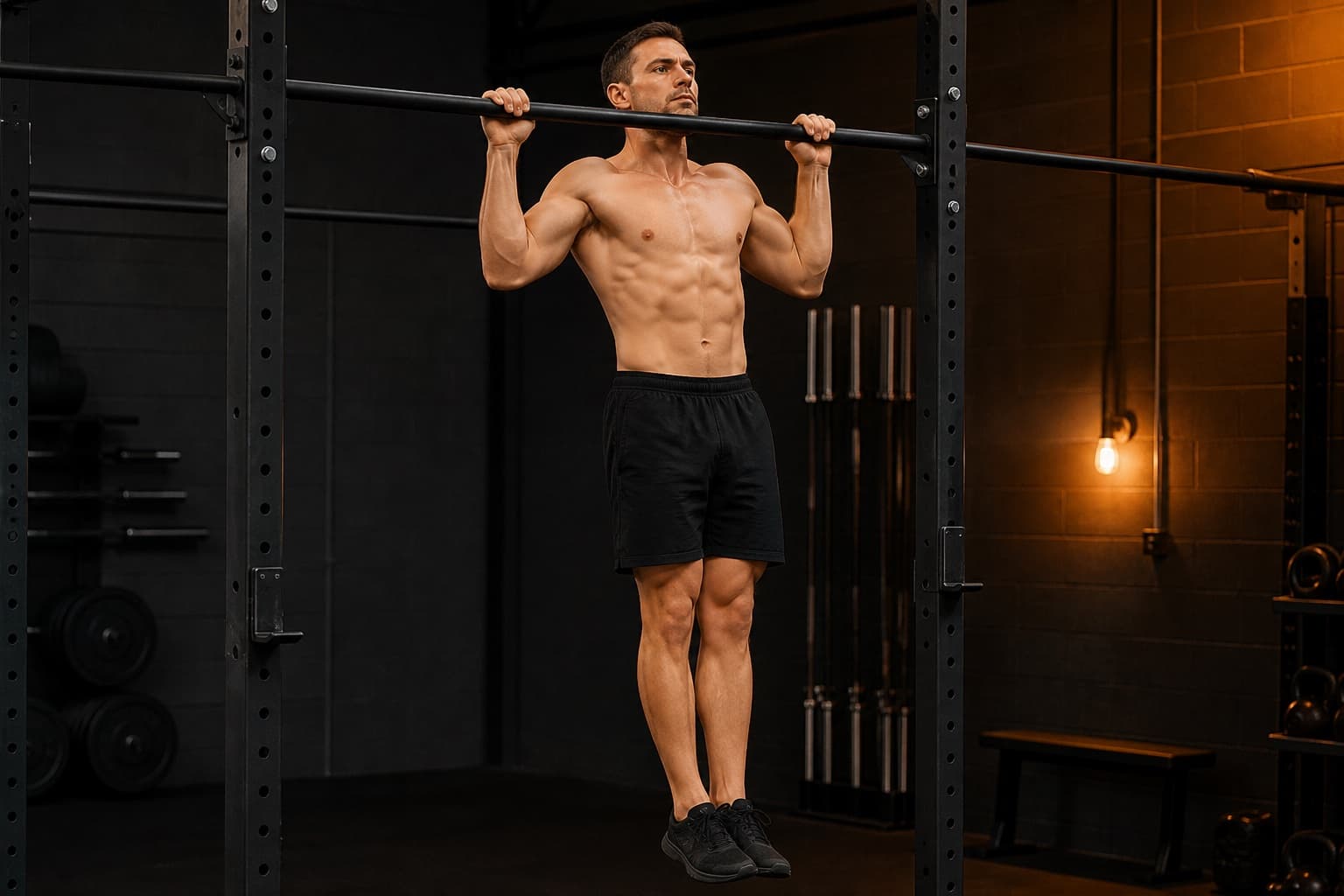
Key position
Pull the elbows toward the ribs and clear the bar without craning the neck or swinging the legs.
Video by CrossFit · reviewed 2026-08-06
The pull-up is the single most important upper-body pulling movement in CrossFit. It develops the lats, biceps, and posterior shoulder while building the grip and core strength necessary for advanced gymnastics skills like muscle-ups and bar muscle-ups. In CrossFit, pull-ups appear in nearly every Hero WOD and benchmark workout, often in high volume. Mastering efficient kip mechanics and developing strict strength are both essential: strict pull-ups build foundational strength, while the kipping pull-up allows athletes to maintain output under fatigue. Both have their place in a complete CrossFit programme.
Quick answer
Strict pull-ups are best for building the strength that supports every faster CrossFit pull-up variation. Scale with a band or feet-assisted row before range of motion or shoulder control disappears.
Muscles Worked
Equipment
| Best for | Foundational upper-body pulling strength, grip development and progression toward CrossFit gymnastics. |
|---|---|
| Avoid if | Shoulder or elbow pain appears, you cannot maintain an active hang, or reps require uncontrolled swinging. |
| Scaling | Band-assisted pull-ups, jumping pull-ups, or ring rows at a 45° angle. |
Grip the bar slightly wider than shoulder-width, palms facing away (pronated grip).
Hang at full extension — arms straight, shoulders active (not shrugged into ears).
Initiate the pull by depressing the scapulae (pull shoulders down and back).
Drive elbows toward the floor as you pull your chin above the bar.
Hold for a brief moment at the top — chest near the bar, chin clearly over.
Lower with control back to full extension before the next rep.
Not achieving full arm extension at the bottom — reduces range of motion and builds bad habits.
Pulling with biceps only rather than initiating with the lats (scapular depression).
High-volume kipping before building enough strict pulling strength and control.
Losing tension in the core during kipping pull-ups, causing excessive swinging.
Build to 5 strict pull-ups before attempting kipping — your shoulders will thank you.
Think "armpits to the bar" rather than "chin over bar" — this cue activates the lats properly.
For high-rep sets (Murph), sub-partition early: sets of 3-5 rather than going to failure.
Band-assisted pull-ups are excellent for building strength; jumping pull-ups maintain the stimulus when fatigued.
Easier / Beginner
Band-assisted pull-ups, jumping pull-ups, or ring rows at a 45° angle.
Harder / Advanced
Strict pull-ups, weighted pull-ups (belt or vest), or chest-to-bar pull-ups.
Training Examples
pull-up progression
Every 2:00 x 6 rounds
3-5 quality Pull-Up reps
Use the listed easier scaling when needed
Finish each set before technical failure
pull-up workout
5 controlled rounds
3-5 quality Pull-Up reps
6-8 reps of the listed easier scaling
Rest 60 sec and repeat cleanly
Strict pull-ups use no momentum — pure upper body strength from hang to chin-over-bar. Kipping pull-ups use a rhythmic swing to generate momentum, allowing more reps under fatigue. Strict builds strength; kipping maintains workout intensity. Both are valid — strict should come first.
A practical benchmark: 5 strict pull-ups gives you the foundation to safely start kipping. 10+ strict is comfortable for intermediate athletes. For Hero WODs like Murph (100 pull-ups), efficient kipping mechanics and smart sub-partitioning matter more than raw max.
Shoulder pain during pull-ups usually signals one of three things: insufficient warm-up, kipping before building strict strength, or not achieving full extension at the bottom. Address all three. If pain persists, consult a physiotherapist before continuing.
The fastest path is usually: (1) ring rows at a progressively more horizontal angle to build the pulling pattern, (2) hollow body work to develop the core tension a pull-up requires, (3) jumping pull-ups with a slow 3-5 second negative (lowering phase) to build eccentric strength in the exact range the pull-up demands. Most people who struggle with pull-ups skip the negatives — that is the most effective single drill.
Butterfly pull-ups use a circular kipping motion instead of the standard front-back swing. They are significantly faster than standard kipping once mastered — elite athletes cycle 30+ per minute. The trade-off: butterfly is harder to learn, harder to recover from, and creates more shoulder demand. If you are still building your pull-up base, master standard kipping first. Butterfly is worth learning once you can do 20+ unbroken kipping pull-ups with ease.
Build It Into a Workout
Use the generator to turn this movement into a full session based on your level, equipment, and training goal. This is the fastest way to move from movement knowledge to real training.
Murph
For Time
U.S. Navy SEAL — Medal of Honor Recipient
Cindy
AMRAP
Named in the CrossFit tradition of naming benchmark WODs after women
Helen
For Time
Named in the CrossFit tradition of naming benchmark WODs after women
Nate
AMRAP
U.S. Navy SEAL — KIA February 4, 2008, Iraq
Badger
For Time
U.S. Air Force — KIA October 26, 2009, Nuristan Province, Afghanistan
JT
For Time
U.S. Navy SEAL — KIA June 28, 2005, Kunar Province, Afghanistan
Generate a WOD that includes this movement, calibrated to your level and equipment.