Lunge Repeatable AMRAP
lunge wod
AMRAP 12
12 alternating lunges
8 controlled air squats
Keep every round within a consistent pace
By Borja Bes — CrossFit Athlete & Hyrox Finisher
Technique demonstration
Watch the full movement, then use the original coaching image to check the key position.
The Walking Lunge
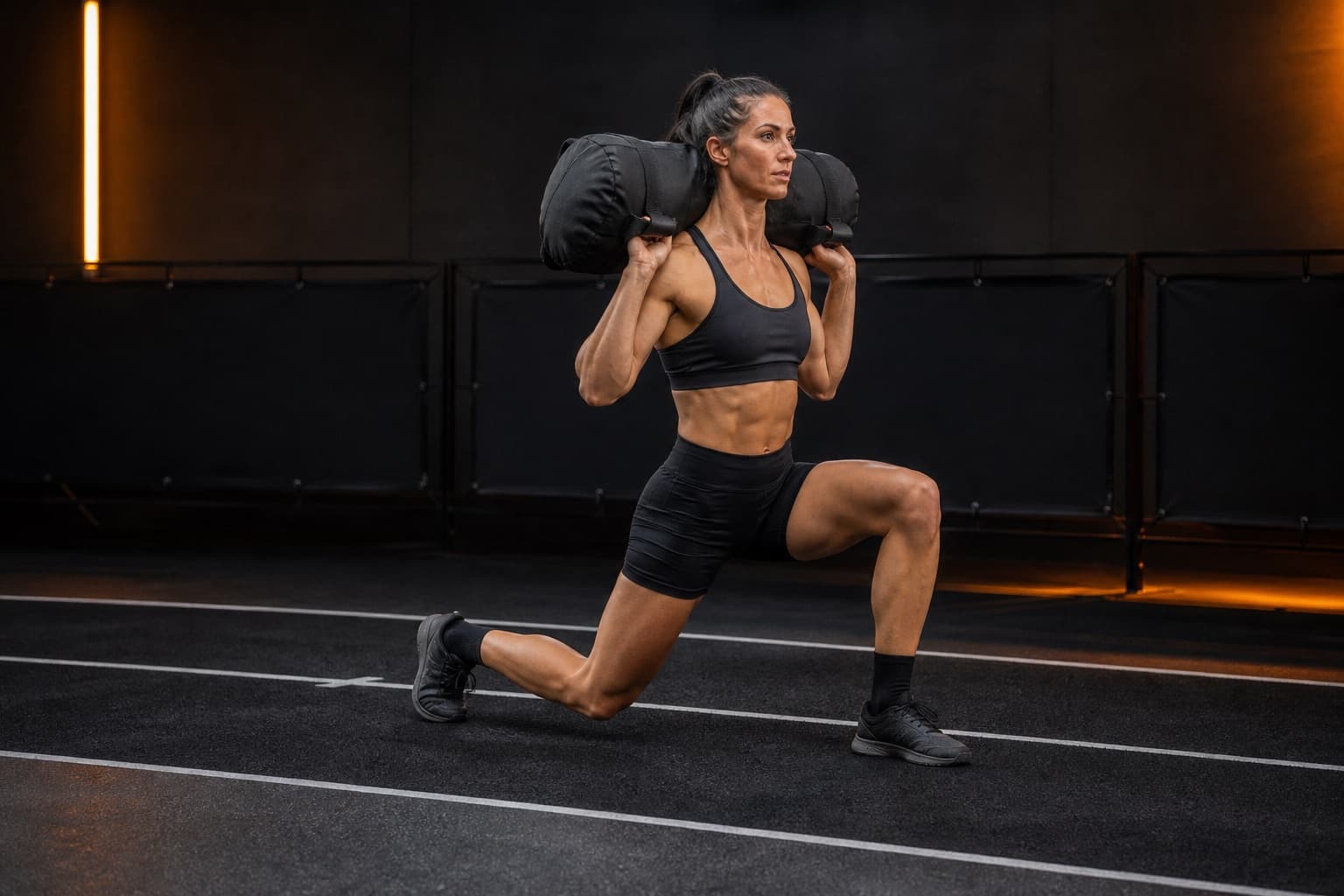
Key position
Keep the sandbag stable, the torso tall and the front knee tracking over the toes as the back knee approaches the floor.
Video by CrossFit · reviewed 2026-08-06
Lunges are a fundamental unilateral lower-body movement that builds strength, balance, and hip mobility. In CrossFit WODs they appear as walking lunges (travelling forward), reverse lunges (stepping back), or in-place alternating lunges, and are counted per leg or per pair depending on the WOD. Lunges expose and address strength asymmetries between legs — a common source of injury in athletes who train exclusively with bilateral movements like squats and deadlifts. As a scaling option for pistol squats and as an accessory to barbell work, they deliver single-leg stimulus with a lower technical barrier.
Quick answer
The loaded walking lunge is best for HYROX leg endurance and stable single-leg strength. Secure the sandbag, keep the front foot flat and use a stride you can repeat without wobbling.
Muscles Worked
Equipment
| Best for | HYROX sandbag-lunge practice, unilateral leg endurance and controlled loaded conditioning. |
|---|---|
| Avoid if | Knee or hip pain changes your depth, the load shifts unpredictably, or balance deteriorates between steps. |
| Scaling | Assisted lunges (hold a rack upright), reverse lunges (easier to balance), shorter range. |
Stand tall, feet hip-width, core braced.
Step forward (or back for reverse lunge) with one leg, landing heel first.
Lower the back knee toward the floor — stop just before contact.
Both knees form approximately 90° at the bottom.
Front knee tracks over the foot — not caving inward.
Push through the front heel to return to standing. Alternate legs each rep.
Front knee collapsing inward (valgus) — cue "knee out" and check glute activation.
Torso leaning excessively forward — maintain upright chest and neutral spine.
Too small a step — the back knee will not reach depth, reducing the range of motion.
Pushing off the back toe rather than the front heel — shifts load away from quads and glutes.
For walking lunges, focus on a long stride — short steps create a quad-only pattern with minimal glute engagement.
Hold a post for balance when learning — removing the balance demand lets you focus on depth and mechanics.
Add a KB or DB in each hand to increase load without changing mechanics — a simple progression.
Easier / Beginner
Assisted lunges (hold a rack upright), reverse lunges (easier to balance), shorter range.
Harder / Advanced
Weighted lunges (DBs or barbell), Bulgarian split squats, or pistol squat progressions.
Training Examples
lunge wod
AMRAP 12
12 alternating lunges
8 controlled air squats
Keep every round within a consistent pace
lunge conditioning
Every 3:00 x 6 rounds
12 alternating lunges
8 controlled bodyweight reps
Rest for the remainder; avoid a first-round sprint
"20 lunges" typically means 20 total steps (10 each leg). "20 lunges each leg" means 40 total steps. When in doubt, ask your coach before starting — the rep count varies by box and WOD.
Build It Into a Workout
Use the generator to turn this movement into a full session based on your level, equipment, and training goal. This is the fastest way to move from movement knowledge to real training.
Generate a WOD that includes this movement, calibrated to your level and equipment.